
Software that doesn't run in production doesn't solve a single problem. What sounds trivial is surprisingly often ignored in practice – with expensive consequences. Many development projects spend weeks or months in planning loops, concept phases and local development environments before the first line of code ever reaches a real user. The result: assumptions that solidify into illusions, technical debt that grows in the shadows, and products that miss the market.
A production-oriented development approach reverses this dynamic. Those who deploy from day one – in small, controlled steps – create the foundation for technical resilience, rapid learning and sustainable trust between all parties involved. At mindtwo, we rely on exactly this philosophy when we develop high-performance web applications and custom software: Deliver, validate, improve – every day.
The dangerous comfort zone of planning
There is a place where every feature works, every integration fits seamlessly and every user does exactly what you expect. This place is not the production environment – it's the head of the development team. You could call it a mental model of the application: an idealized image where complexity doesn't yet exist because it hasn't yet collided with reality.
Planning phases, brainstorming sessions and requirements documents are undoubtedly important. But they become dangerous when they become an end in themselves. Because every feature that only exists on the whiteboard, every architectural decision that only exists on paper, lives in a world without:
- Legacy data that doesn't fit the desired form,
- external APIs with rate limits and breaking changes,
- performance bottlenecks under real load,
- security requirements and data protection regulations,
- real users with unpredictable behavior.
As long as code doesn't run in production, these challenges remain invisible. Assumptions about technical feasibility and product success remain untested. And the longer this state persists, the greater the gap between expectation and reality becomes.
Why the real problems live in production
The notion that software development primarily consists of writing code falls short. Generating code is becoming – not least through AI-powered tools – increasingly easier and cheaper. What remains challenging, however, is operating software that works reliably under real conditions.
A productive application is more like a factory than a workpiece: data flows in specific formats and rhythms, subsystems must be coordinated, new modules are integrated – ideally without downtime. At the same time, there are external disruptive factors: DDoS attacks, expiring certificates, incompatible API updates, unexpected load spikes.
These problems don't appear in the local development environment or in a concept document. They only show themselves in production. And that's exactly why an early path there is so crucial: Those who solve their most difficult problems first radically reduce project risk.
The 80 percent problem
A pattern we repeatedly observe at mindtwo in strategic consulting: Companies come with the statement that they are "80 percent complete" and just need support for the final polish. Upon closer inspection, it often turns out that models, controllers and basic structures have been created – the skeleton of an application. But the really hard tasks are still pending: data migration, integration tests, queue management, caching strategies, permission logic.
The truth is: if the most difficult technical problems haven't been solved yet, you're far from 80 percent. Often, solving these hard problems is what first defines what form the application must actually take.
Proving technical viability – not assuming it
The only reliable proof that a technical solution works is its function in production. Local tests, staging environments and code reviews are indispensable quality assurance measures – but they can only approximate, never fully replicate, the conditions of real production.
Typical production problems that only become apparent under real conditions include:
- Long-running processes: Jobs that require several hours and whose state management is complex.
- Data inconsistencies: Historical data that doesn't match the assumptions of the new feature.
- External dependencies: Storage providers, mail services, DNS configurations and caching layers, each bringing their own sources of error.
- Scaling behavior: Performance characteristics under real load that are difficult to simulate in artificial test environments.
The DORA Report (Accelerate State of DevOps) published annually by Google confirms this relationship empirically: Teams that deploy more frequently – ideally multiple times daily – achieve significantly better values for lead time, change failure rate and mean time to recovery. Deployment frequency is not just an indicator of speed, but of the overall maturity of a development process.
Product viability: Rapid learning instead of long assumptions
Alongside technical viability stands the equally critical question of product viability: Does the software actually solve a problem that people are willing to pay for? Will users understand and regularly use the application?
As long as a product only exists as a concept, all answers to these questions are hypotheses. And hypotheses have an uncomfortable property: they can be wrong. The crucial question is not whether an assumption deviates from reality, but when you find out.
The principle of failing fast
Those who develop for a week and then deliver a function quickly learn whether the hypothesis is correct. Small corrections keep the product on course. Those who build for six months without user feedback risk that an initially small deviation has grown into a fundamental misalignment.
Failing fast is not a failure – it's one of the most valuable sources of information. It delivers high-quality data about what works and what doesn't. And this data only arises in production, not in the planning phase.
The scientific basis for this is solid: Research on Continuous Delivery shows that frequent, small releases not only reduce the error rate but also increase product quality because feedback loops are drastically shortened.
Trust and costs: The underestimated dimension
An aspect that often gets lost in technical discussions is the connection between delivery speed and trust. Whether internal team or external service provider: those who don't deliver visible results for weeks erode the trust of their clients – regardless of how intensively work is being done in the background.
Concept phases and planning cycles cost money. They are justified when they lead directly to implementable results. But when planning becomes a permanent occupation, the cost-benefit ratio shifts dramatically. Every day without deliverable results is a day when budgets are burned without generating measurable progress.
For companies working with external partners, this means: The right development partner delivers from day one – not after a multi-week analysis phase.
Strategies for continuous deployment
The theory is convincing – but how do you implement a production-first approach in practice? Especially with existing applications with legacy code and grown data structures, this is not a trivial task. Three strategies have proven particularly effective.
1. Building in vertical slices
The natural impulse with a new feature is often to proceed horizontally: first all the backend logic, then all the tests, then the controllers, finally the frontend. The problem: until the feature is complete, there's nothing to show – and if it turns out at the end that the user experience should have been designed differently, everything collapses.
The alternative is the vertical slice principle: instead of building in layers, you identify the thinnest possible full-stack function that can be delivered today. A vertical slice includes backend, frontend and tests – and is so narrow that it can be deployed in a single, manageable pull request.
The advantages of this approach are significant:
| Aspect | Horizontal Construction | Vertical Slices |
|---|---|---|
| Time to first result | Weeks to months | Hours to days |
| Risk of direction change | High – everything must be rebuilt | Low – next slice adapts |
| PR size | Thousands of lines, hard to review | Manageable, quick to check |
| Feedback cycles | Very long | Continuous |
| Team momentum | Slowly building | Immediately noticeable |
Vertical slices also force a productive conversation about what delivers the greatest value next. Instead of working through a monolithic feature block, a prioritized stream of small, valuable increments emerges.
2. The strangler fig pattern for legacy systems
For companies that need to modernize existing applications, the Strangler Fig Pattern first described by Martin Fowler offers a structured migration path. The metaphor comes from the strangler fig, a tree that grows on another tree: it first sends down a single vine until it reaches the ground and can absorb nutrients. Then more vines follow until the new tree has completely enveloped the old one.
Translated to software development, this means: Legacy systems are not replaced in one big throw, but step by step – functionality by functionality. Each new component is built as an independent, vertical slice alongside the existing logic. As soon as it's production-ready, it takes over the role of its legacy counterpart.
This approach massively reduces migration risk. Instead of a frightening big-bang release, a controlled, gradual transition emerges. And because each step is deployed and validated individually, the team maintains control over the process at all times.
Especially when replacing or modernizing existing web platforms, this approach is a proven standard: minimize risks, ensure operational continuity, create value step by step.
3. Feature flags as deployment enablers
Feature Flags – also called feature toggles – are the technical key that enables continuous deployment even with large, risky changes. The principle: new code is deployed to production but hidden behind a switch. Only when the function is ready is it activated for selected or all users.
The use cases are diverse:
- Gradual rollouts: Activate new features initially only for a small user group and immediately roll back if problems occur.
- Internal preview use: The team uses the new function internally before it becomes public – and finds bugs and UX problems under real conditions.
- Parallel development: Multiple teams work simultaneously on different features without blocking each other.
- Decoupling of deployment and release: Code can be deployed at any time; the release timing is controlled independently.
Even extensive refactorings – such as introducing a new data model that affects all existing entities – can be performed behind a single feature flag. The advantage: the change already lives in production, is tested and hardened there, months before it becomes visible to end users.
Approximating the local environment to reality
Another often underestimated lever lies in the design of the local development environment. Typical seeders generate small, well-formed data sets that precisely map the happy path. Production data, however, is large, irregular and full of historical inconsistencies.
Those who work locally exclusively with idealized test data regularly experience unpleasant surprises during deployment. The better alternative – where legally and technically possible – is anonymized production data in the development environment. It forces you to deal with the real data situation already during development.
The same principle applies to external services: API sandboxes are superior to mocks because they better represent the actual behavior of the interface. The closer the local environment comes to production reality, the more smoothly subsequent deployments proceed.
A structured path to continuous delivery
For companies that want to transform their development process toward continuous delivery, a step-by-step approach is recommended:
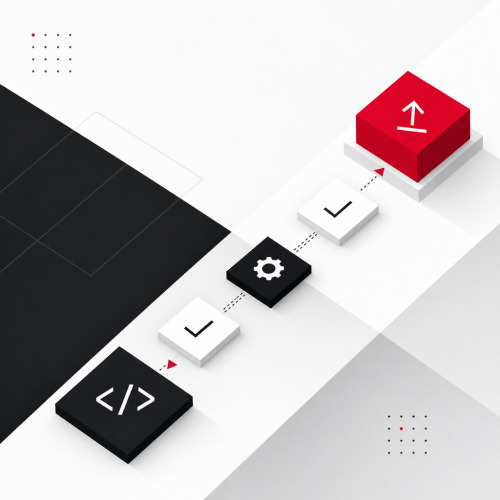
- Establish deployment pipeline: Create automated tests, build processes and deployments as a technical foundation.
- Introduce feature flags: Establish the decoupling of deployment and release as an organizational tool.
- Sharpen pull request culture: Small, reviewable PRs instead of monolithic feature branches. Fast review cycles are essential.
- Vertical slices as standard: Train teams to break features down into the thinnest possible full-stack increments.
- Use production data: Equip local environments with realistic data to minimize surprises.
- Shorten feedback loops: Internal use of new features under real conditions before public rollout occurs.
This process requires not only technical adjustments but also organizational rethinking. Review processes must be accelerated, ticket systems used efficiently, and prioritization decisions made continuously. But the effort is worthwhile: the result is teams that deliver value daily – instead of working for months toward a large release.
Why the investment is worthwhile
The advantages of a production-oriented development approach work on several levels simultaneously:
- Risk reduction: Small, frequent changes are easier to control and roll back than large releases.
- Faster time-to-market: New functions reach users in days instead of months.
- Higher product quality: Short feedback loops enable continuous improvement based on real usage data.
- Stronger trust: Regular, visible progress creates trust among stakeholders and clients.
- More efficient resource use: Less wasted development time through early validation of assumptions.
- Future-proof architecture: Vertical slices and the strangler pattern lead to modular, maintainable systems.
Conclusion: The factory beats the ivory tower
Developing software doesn't mean forging perfect plans. It means putting working solutions in the hands of real users – as early and as frequently as possible. Every day that code only exists locally is a day without valid insights about technical feasibility and product success.
The strategies for this are proven: vertical slices for rapid delivery, the strangler fig pattern for safe migration, feature flags for controlled rollouts, and reality-oriented development environments for fewer surprises. Together, they form a framework that works for both new projects and the modernization of existing systems.
Those who want to develop their digital platform, web application or custom software with this standard – precisely, incrementally and production-oriented – will find in mindtwo a partner who works exactly this way: From day one in production, a little better every day.