
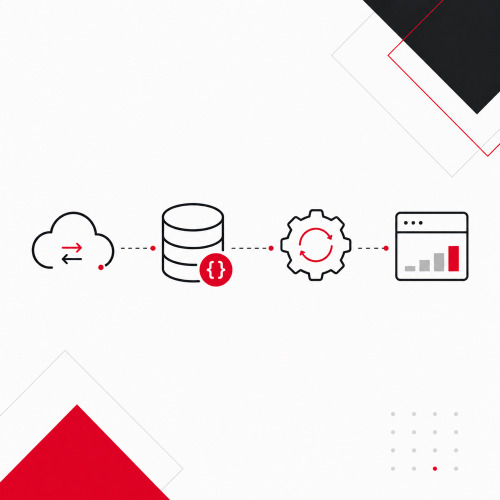
Anyone who integrates external data sources into their own web application will sooner or later face a familiar problem: The first version of the import works flawlessly on the development machine, but fails in production due to rate limits, growing data volumes, and unreliable third-party APIs. What begins as a simple cron job must evolve in practice into a resilient sync engine that can cope with real-world conditions.
Especially with custom web applications and software solutions that depend on the integration of external data sources, the architecture of the data import decisively determines the stability, costs, and scalability of the overall system. This article describes proven architecture patterns that we use at mindtwo to reliably, efficiently, and future-proof synchronize large amounts of data into web applications.
Why classic import jobs reach their limits
The typical approach to fetching external data into your own application is remarkably simple: A job iterates over a paginated API and saves the results in the database. With a hundred records, this works flawlessly. With a hundred thousand, it gets slow. With a million, it becomes a problem.
The N+1 problem with API imports
Many external APIs only deliver basic data at the overview level. Detailed information requires additional requests per record. On top of that come nested resources, such as transactions for a property or order items for an order. What was planned as a linear traversal quickly explodes into a combinatorial challenge:
- 1 million master data records with 5 linked detail resources each
- 6 API requests per record (1 master + 5 details)
- With an average response time of 2 seconds, this results in around 12 million seconds of runtime, which corresponds to approximately 19 weeks of continuous import time.
Such numbers are not a theoretical exercise. They occur in practice as soon as an application seriously works with external data sources, whether in real estate, e-commerce, logistics, or the integration of government and industry data.
Why simple parallelization is not enough
The obvious solution is: Parallelization via queue workers. Instead of processing requests sequentially, the work is distributed across dozens or hundreds of workers that operate simultaneously. From 19 weeks, with 100 workers, this theoretically becomes around one and a half days of runtime.
In practice, however, you quickly encounter a fundamental problem: Rate limiting. Hardly any external API allows unlimited requests per time unit. Even well-documented APIs often have tiered limits, such as 40 requests per 10 seconds and simultaneously 200 requests per 60 seconds, as documented in current API best practices. Undocumented limits, as they occur with public or government APIs, make things even more unpredictable.
The thundering herd problem with distributed queue workers
When rate limit checks happen per worker, a dangerous illusion arises: Each individual worker believes it is below the limit, without knowing that 99 other workers are simultaneously sending requests. The result is massive 429 Too Many Requests responses.
The retry behavior becomes even more problematic: All workers sleep the same backoff time after an error, wake up simultaneously, and immediately generate the next surge. This thundering herd problem is a classic performance problem in distributed systems where many processes simultaneously access a shared resource.
The result is not only failed synchronization, but in the worst case a temporary or permanent block by the API provider. Anyone who has been blocked from a critical data source for several weeks won't forget this scenario easily.
Solution: Central rate limit coordination via Redis
Instead of letting each worker manage its own rate limit logic, a central control mechanism has proven effective:
- A shared retry-after timestamp in Redis serves as the "single source of truth."
- Before each API request, the worker checks this timestamp.
- If a rate limit window is imminent, the worker sleeps until the allowed time.
- Sleeping workers block the queue and thus prevent further jobs from triggering requests.
The elegant consequence: The queue regulates itself. Sleeping workers act as a natural brake, without the need for complex coordination logic between workers. As soon as the rate limit window opens, the first worker continues working, updates the timestamp if necessary, and the cycle begins anew in a controlled manner.
Additionally, implementing jitter, a random delay when workers wake up, is recommended to avoid synchronized retry surges. This approach is part of established progressive backoff strategies.
Separating import and publish: Raw data as a strategic buffer
An often underestimated problem with data imports: Requirements change. Today address and purchase price are sufficient, tomorrow the business team additionally needs lot size and year of construction. If this information was contained in the API response but was not saved during import, the only option is a complete reimport, with all the costs and risks described.
The import-publish pattern
The solution is to conceptually separate the data import into two phases:
| Phase | Task | Characteristics |
|---|---|---|
| Import | Retrieve raw data from the API and save as JSON | Slow, network-dependent, rate-limited, error-prone |
| Publish | Transfer raw data into structured tables | Fast, local, idempotent, can be repeated indefinitely |
The import phase saves the complete API response as JSON in a _raw table. The publish phase reads this raw data and projects it into the actual application tables, with exactly the columns and transformations currently needed.
This pattern is reminiscent not coincidentally of event sourcing: The raw data acts as an immutable event source from which new projections can be derived at any time. Anyone working in the big data environment will also recognize parallels to the so-called medallion architecture (bronze layer as raw data level). If the business team needs a new column, a republish is sufficient without a single additional API request.
Advantages at a glance
- Flexibility: New requirements do not require a reimport.
- Auditability: The original API response is preserved.
- Error tolerance: Publish errors are local and quickly correctable.
- Efficiency: Only the import phase consumes API quota.
- Idempotency: Publishes can be repeated indefinitely.
Progressive backoff: Intelligent rechecking instead of brute force
Even with parallelized, rate-limit-compliant imports, the fundamental problem grows steadily: Each new record that is imported must be checked again in future sync runs. With a million records that are synchronized every two hours, the import can quickly take longer than the interval, a classic vicious circle that leads to queue overflows and resource bottlenecks.
Data-driven prioritization
A key insight from practice: Recently updated records are much more likely to change again than records that have been unchanged for months. This pattern can be used for an intelligent recheck system:
| Last change | Next check |
|---|---|
| Just now | In 12 hours |
| Unchanged for 12 hours | In 24 hours |
| Unchanged for 24 hours | In 48 hours |
| Unchanged for 48 hours | In 1 week |
| Unchanged for 1 week | In 1 month |
| Unchanged for 1 month | In 1 year |
As soon as a change is detected, the system resets the timer to the shortest interval. This progressive backoff pattern drastically reduces the checking volume: If only 5% of records are actually updated per day, over multiple sync cycles typically 80 to 95% of API requests can be saved without significant information loss.
Alternative prioritization criteria
The age of the last change is just one possible dimension. Depending on the use case, other criteria are suitable:
- Business criticality: Check records from high-revenue customers first.
- Complexity: Prefer records with few linked resources to quickly achieve throughput.
- Volatility: Prioritize records from categories with high change rates.
- Usage frequency: Keep records that are frequently accessed by end users more current.
It is crucial that the prioritization logic is adapted to the technical requirements of the respective project. There is no one-size-fits-all solution, but there is a proven basic pattern.
The four pillars of a robust sync engine
From the described challenges and solutions, a recurring architecture pattern can be derived that is suitable for most scenarios of third-party data synchronization:
1. Multi-threaded execution
Parallelization via queue workers is essential for acceptable import times. Distributing the work across multiple workers shortens the total runtime by orders of magnitude.
2. Centralized rate limiting
Rate limit checks must not take place per worker. A central mechanism, such as via Redis, ensures that all workers operate together within the allowed limits. Only in this way can the thundering herd problem be reliably avoided.
3. Import-publish separation
Raw data is first saved completely and unprocessed. The transformation into application-specific structures takes place in a separate, local step. This separation creates flexibility, auditability, and efficiency.
4. Intelligent rechecking
Instead of checking all records with the same frequency, a record's activity determines its check frequency. Progressive backoff strategies dramatically reduce the overall volume and prevent sync runs from exceeding their own time window.
Architecture decisions instead of lines of code: What really counts
The described patterns illustrate a fundamental shift in software development: The value increasingly lies not in the amount of code written, but in the quality of architectural decisions. A naive import job can be written in a few lines of code, even with AI support. However, the challenges that arise in production—rate limits, growing data volumes, network errors, and changing requirements—require experience and forward-thinking planning.
Especially with data-intensive applications such as real estate platforms, e-commerce aggregators, industry dashboards, or IoT backends, strategic consulting in the conception phase is crucial. Anyone who sets up the data architecture correctly from the start saves costly reimports, production outages, and technical debt.
Data as a strategic asset
In many projects, the actual value is not created by the user interface, but by the quality and timeliness of the underlying data. External data sources such as public APIs, industry databases, and partner interfaces are imported, enriched, linked, and refined. This transformed data is often the actual product.
All the more important is it to not treat data import as a side show, but as a critical infrastructure component with its own architecture, its own monitoring, and its own development strategy.
Technical implementation: What matters in implementation
The practical implementation of a robust sync engine requires well-thought-out decisions on multiple levels:
Queue infrastructure
- Dedicated queues for import jobs, separated from the regular application queue
- Overflow protection: Mechanisms that prevent new sync runs from being started while the previous one is still active
- Monitoring: Real-time insight into queue depth, worker utilization, and error rate
Database design
- Raw tables with JSON columns for the unprocessed API responses
- Indexed metadata such as
last_checked_at,last_changed_at, andnext_check_atfor the progressive backoff system - Batch processing during publish to minimize database load
Error handling
- Idempotent jobs: Each job can be safely repeated on error without corrupting data.
- Dead letter queues for permanently failing jobs
- Alerting for unusual error rates or API failures
For API development and the integration of external interfaces, we at mindtwo rely on proven tools and patterns from the Laravel ecosystem, from specialized HTTP client abstractions to customized queue strategies.
Search integration as a complement: Making imported data searchable with performance
Large imported data sets must not only be stored, but also be searchable with performance. Specialized search engines like Typesense enable full-text search across millions of documents in milliseconds, a significant difference from conventional SQL LIKE queries.
For integration into Laravel-based applications, Scout integrations are suitable, which automatically keep the search index synchronized with the database. The challenge here too lies in synchronization with large amounts of data: When hundreds of thousands of records are updated, the search index must efficiently catch up, ideally via batch imports and buffer tables instead of individual HTTP requests per document.
Best practices for search integration include:
- Minimal indexing: Only index fields that are actually searched or filtered.
- Structured content: Set up headings, metadata, and content as separate fields.
- Configure stop words: Exclude common filler words to improve relevance.
- Consider multi-tenancy: Use separate indexes or filter strategies for multi-tenant systems.
Performance optimization in ongoing operations
A sync engine is not a project with an end date, but a living component that requires continuous attention. Performance optimization affects not only the response times of your own application, but also the efficient use of external resources.
Important metrics for ongoing monitoring:
- Queue throughput: How many jobs are processed per time unit?
- API error rate: How often do 429 or 5xx errors occur?
- Sync freshness: How current is the imported data on average?
- Resource consumption: CPU, RAM, and network traffic of workers
- Import-to-publish ratio: How many imports actually lead to data changes?
These metrics form the basis for data-driven optimizations, such as adjusting backoff intervals, scaling the number of workers, or identifying inefficient API endpoints.
Conclusion: Data architecture as a competitive advantage
The integration of external data sources is one of the most demanding tasks in modern web development. What looks like a simple API call at first glance requires well-thought-out architecture in practice: centralized rate limiting against the thundering herd problem, import-publish separation for long-term flexibility, and progressive backoff for sustainable resource management.
The good news: These patterns are proven, reusable, and transferable to a wide variety of domains, from real estate platforms to e-commerce aggregators to industry dashboards and IoT backends.
In a time when code generation is becoming increasingly accessible, the actual value lies in the ability to make the right architectural decisions before the first production problems occur. Anyone planning a scalable web application that relies on external data should treat data synchronization from the start as a standalone architectural component, not as a side project that will somehow work eventually.
Are you planning a data-intensive application with external interfaces? Contact us. Together we will analyze your data architecture, identify critical scaling paths, and develop a sync strategy that not only works on day one, but also holds up in two years.