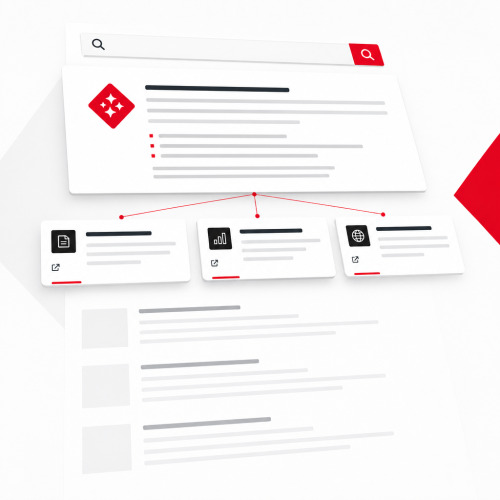

Generative answers are handling more and more searches directly on the results page. The path back to visibility leads through better SEO, not through a new discipline alongside it. What this means for budgets, content and metrics is explained in this article from the practice of AI SEO and GEO.
What the AI answer does to your clicks
In Germany, an AI overview already appears for around one-fifth of all search queries, and for longer and more specific questions it's already around 30 percent.¹ In almost four out of five cases, this answer appears above the first organic results.¹ The first stage of search is thus shifting upward, the classic search results list begins further down and with it the ranking at position 1.
The consequences for the click-through rate are measurable:
| Metric | without AI answer | with AI answer |
|---|---|---|
| Click-through rate at position 1 | 27% | 11% |
| Share of searches that lead to a click | 57% | 33% |
*Data basis: Analysis of over 100 million keywords for the German market.*¹
Extrapolated to the overall market, this results in around 265 million missing organic clicks per month, on average about 6.6 percent of organic traffic.¹ The demand itself is not shrinking: the number of search queries is even increasing, because more questions can be asked with an AI answer.² What is lost is not the search interest, but access to the primary knowledge sources.
The loss is distributed very unevenly. Pure information-driven offerings are hit hardest: health portals, for example, lose between 24 and 30 percent of their clicks.¹ Transactional and current searches, however, remain almost untouched, with losses sometimes below two percent.¹ This leads to the first question of any assessment: How much of our organic traffic is based on knowledge questions that a generative answer handles in three sentences?
Questions are getting longer
Since October 2025, Google Search's AI mode has also been available in German.³ Questions asked there are on average almost three times as long as classic search queries.³ This fundamentally changes the task. Optimization is no longer for a keyword, but for a question complex with context, conditions and follow-up questions. Longtail keywords are no longer a remainder, but the normal case, and clean work on search intent determines whether a page even comes into question as an answer candidate.
Why SEO is now becoming the central strategy
The basics are the AI strategy
For the AI features of search, Google does not describe any separate optimization. The requirements are the familiar ones: the page must be indexed, allow snippets, remain accessible to crawlers, carry its essential content in the text, and mark up structured data congruently with the visible content. The Core Web Vitals also remain part of the recommendation.
This sounds reassuring, but it's not. If there is no special discipline that can be purchased separately, the quality of the basic work decides on visibility in both worlds simultaneously. AI SEO is therefore not an additional item alongside search engine optimization, but its significantly tightened requirement. Those who don't meet this will lose in organic search and will have to counter expensively with other advertising means.
The middle tier in search results is disappearing
A results list has ten places, an AI answer names a handful of sources. Those who previously got scraps on the back pages of organic search results no longer appear in the answer. Visibility concentrates on the sources that cover a topic most reliably. For companies with solid but interchangeable content, this is the real message. Especially non-directly transactional pages, and thus also many B2B pages, have no choice anymore: if they want to remain visible, they must start with AI SEO now and make it the overarching strategy of the website.
What this means for budget logic
As long as search engine optimization ran as a sideline, the calculation was simple: a few texts per quarter, a technical check per year, the rest followed. That no longer adds up. If part of the information-driven clicks is permanently lost, a gap emerges that must be closed either through better organic presence or through purchased reach. The second option is the more expensive one and ends with every stopped budget.
Practically, this means a shift in resources: fewer topics, but in depth; less text production, but an editorial process with professional review; and SEO planning that begins before content, not after.
The end of 300-word texts
Short guide texts that serve a keyword and then say nothing more were never particularly good. Now they are almost ineffective. It is precisely this standard knowledge that a generative answer summarizes in a few sentences, without anyone clicking.
Only what a generic answer cannot deliver has an effect:
- Own data (data sovereignty): evaluations from one's own operations, from projects or from measurements that no one else has.
- Decisions instead of lists: a justified recommendation including the cases in which it does not apply.
- Practice with pitfalls: what goes wrong in implementation, what causes it and how to avoid it.
- Context: why a development is relevant, for whom, from when and with what consequences.
- Demonstrable timeliness: verified information with date instead of knowledge from the day before yesterday.
Structure that machines can read cleanly
Depth alone is not enough if a text cannot be broken down. AI systems extract individual blocks and assemble an answer from them. What is rewarded is therefore what is clearly delimited: headings that name a real question, paragraphs that stand on their own, definitions in one place instead of distributed throughout the text, tables for comparables and lists for countables.
This creates a dual task: the text must be readable for humans and decomposable for machines. Both succeed with the same means, namely careful editorial work.
Real content instead of marketing speak
A phrase like "leading solution for demanding requirements" contains no verifiable information. People skim over it, language models cannot extract anything from it. Both target groups now evaluate the same thing: substance.
A text becomes reliable through details that can be verified:
- Numbers with origin and date instead of vague magnitudes.
- Named authors with function and professional background.
- A visible update date and a process that justifies it.
- Clear information on limits and exceptions of a recommendation.
- References to primary sources where a statement is contentious.
These points are simultaneously the core idea of E-E-A-T: demonstrable experience, expertise, authority and trustworthiness. Authority cannot be claimed, it emerges from evidence. Those who build it up over years become the source from which the answer quotes.
What successful AI SEO brings to companies
Presence at the point where decisions are made
For many searches, the AI answer is the first and sometimes only point of contact. Those who appear there as a source are considered in the evaluation, even without a click. This visibility works like a third-party recommendation and contributes to the brand, long before an inquiry arises.
Clarity about the value of one's own traffic
The decline in click numbers is documented. Whether the remaining visits are on average more purchase-ready can only be seriously checked per website, through conversion rates and inquiry quality instead of traffic curves. Those who evaluate their own data this way recognize early which content continues to bring business and which only reported volume. AI SEO only works with detailed monitoring.
A lead with a long half-life
Topic authority develops slowly and is difficult to catch up with. A competitor who starts today is not competing against individual texts, but against years of cultivated professional depth. This is precisely the economic core of AI SEO: the effort is high once and difficult to copy afterwards.
New metrics for AI search
Ranking and clicks don't lose their significance, but they only partially describe the result. Control needs additional guiding questions:
| Previous guiding question | Supplementary guiding question |
|---|---|
| Do we rank at position 1? | Are we cited as a source in the AI answer? |
| How much traffic does the keyword bring? | How many searches on this topic still lead to clicks at all? |
| How many texts appear per month? | How many topics do we cover reliably in depth? |
Google Search Console shows clicks from AI features in the performance report under "Web", so the development in one's own inventory can be tracked. Additionally, the question belongs how often one's own brand is mentioned in generative answers. How stable rankings and collapsing traffic diverge is shown in the article on AI visibility.
The next steps for your AI SEO
- Evaluate inventory: Which pages live from knowledge questions, which from purchase, booking or location intent? The first group is under pressure.
- Bundle topics: Instead of many thin articles, cover a few topic areas in depth and link them internally cleanly.
- Check technology: Indexability, snippet release, text availability without JavaScript, structured data and loading times are the entry ticket.
- Set up editorial: fixed responsibility, professional review, update cycles and named authorship.
- Expand measurement: include AI clicks, mentions and conversion quality in reporting, not just positions.
Frequently asked questions about AI SEO
What is AI SEO?
AI SEO refers to the alignment of a website with search systems that summarize results in generative answers, such as AI Overviews and Google Search's AI mode. The goal is to appear as a cited source in the answer and simultaneously rank in classic search results. The basis is uniqueness, professional depth and demonstrable authority.
Does AI SEO replace classic search engine optimization?
No. The technical and content requirements are the same, they are just evaluated more strictly. Indexing, clean structure, loading times and helpful content remain the basis. AI SEO extends this basis to include citability and metrics beyond position and click.
How long must a text be for AI search?
Length is not a target value. What is decisive is whether an article fully answers a question and delivers something that a short AI answer cannot represent. Short texts without their own contribution lose their function because the standard knowledge is already in the answer.
How do we recognize whether AI SEO is working?
By three signals: by clicks from AI features in the Search Console performance report, by mentions of one's own brand in generative answers, and by the quality of inquiries instead of pure visitor numbers. Positions remain useful as an early indicator, but are no longer sufficient as the sole standard.
Sources
- SISTRIX, analysis of AI Overviews and click-through rates in Germany based on over 100 million keywords, as of 21.08.2026.
- SISTRIX, evaluation of the development of AI search and the use of generative search offerings, as of 21.08.2026.
- OnlineMarketing.de, report on the global rollout of Google AI mode including German language, 08.10.2025.
Related topics
- LLM SEO: becoming visible in AI answers
- Content Hub: structure creates topic authority
- Branded Search: your brand is the best keyword
- Writing texts for websites